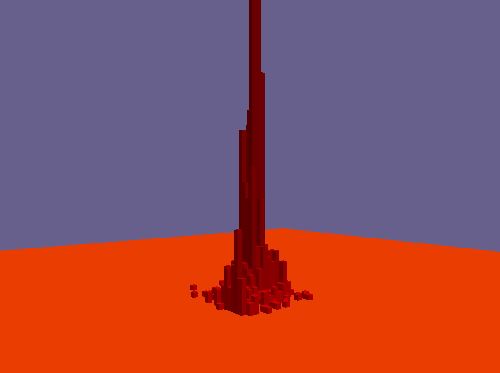
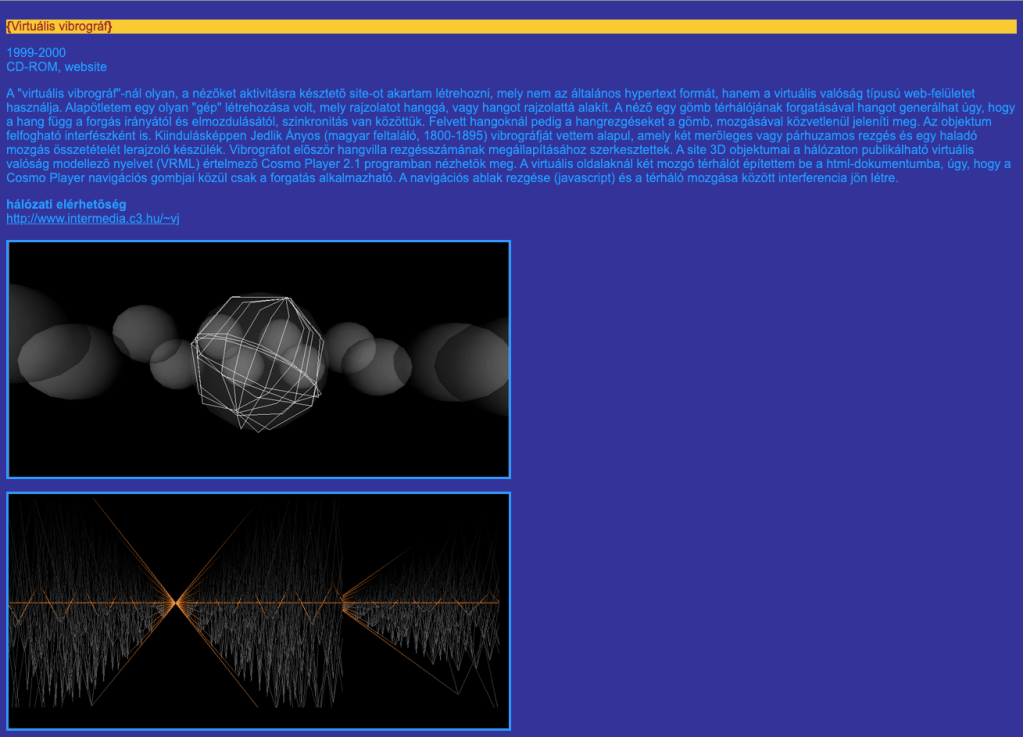
“For the virtual vibrograph I wanted to create a site that would make the viewer active, using a virtual reality type of web interface rather than the usual hypertext format. My basic idea was to create a “machine” that turns drawing into sound, or sound into drawing. The viewer can generate sound by rotating a spatial mesh of a sphere so that the sound depends on the direction and displacement of the rotation, there is synchronicity between them. And for recorded sounds, the sound vibrations are directly represented by the movement of the sphere. The object can also be conceived as an interface. As a starting point, I have taken the vibrograph of Ányos Jedlik (Hungarian inventor, 1800-1895), a device that draws the composition of two perpendicular or parallel vibrations and a progressive movement. Vibrographs were first constructed to measure the number of vibrations of tuning forks. The 3D objects on the site can be viewed in Cosmo Player 2.1, which interprets the virtual reality modelling language (VRML) that can be published on the web. For the virtual pages, I have included two moving spatial grids in the html document, such that only the rotation of the Cosmo Player navigation buttons is applicable. There is interference between the oscillation of the navigation window (javascript) and the movement of the spatial mesh.” (Júlia Vécsei)
The work was Realized as both a Cd-Rom and a website.

URL: https://web.archive.org/web/20080408051630/http://www.intermedia.c3.hu/~vj/index.html
https://web.archive.org/web/20080607092200/http://www.intermedia.c3.hu/koln/vecsei.html