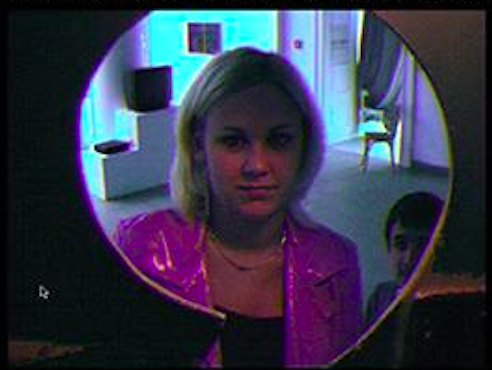
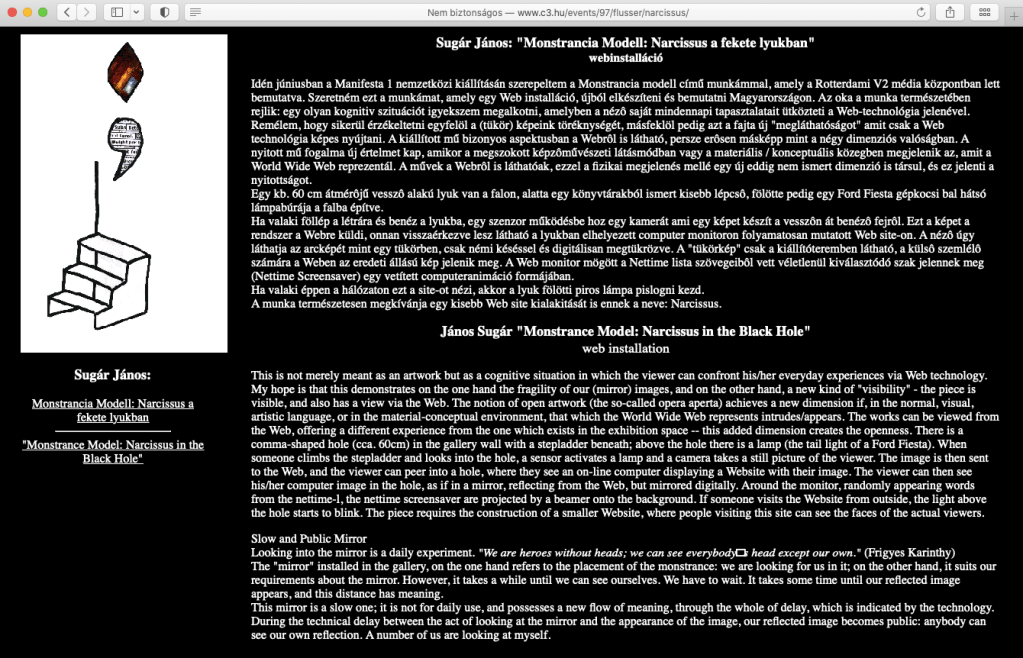
János Sugár’s Monstrance Model: Narcissus in the Black Hole is a web installation that transforms the act of self-reflection into a communal and technological experience. The piece juxtaposes traditional notions of a mirror with digital technology, creating a “slow mirror” that emphasizes the fragility and public nature of our self-images. Viewers climb a stepladder to peer into a comma-shaped hole in a gallery wall, activating a sensor that captures their image and uploads it to the web. As their digital reflection appears on a monitor within the hole, it is mirrored back to them, surrounded by projected words sourced from the internet. This delay between looking and seeing highlights a new kind of “visibility” shaped by technology, where personal reflection becomes a shared, public act. The installation blurs the boundary between private and public, physical and digital, and challenges the immediacy of traditional self-perception, embodying the concept of open artwork (opera aperta) in a networked era.
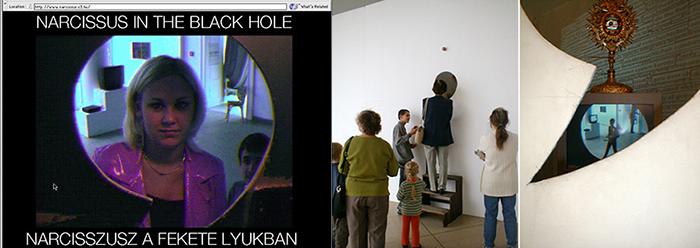
Exhibited at Manifesta 1, Rotterdam, 9 June-19 August, 1996