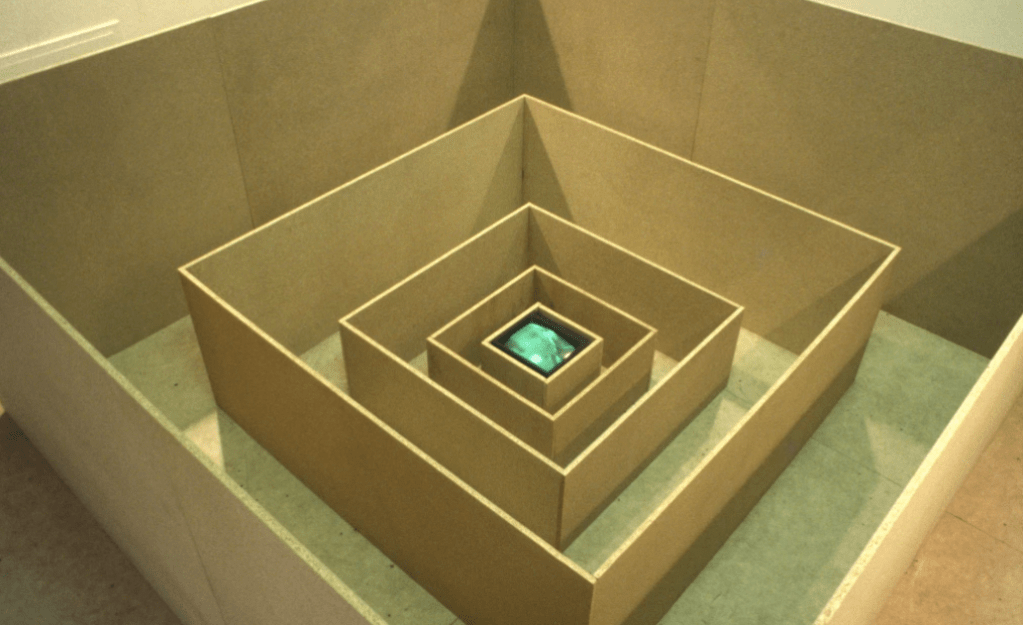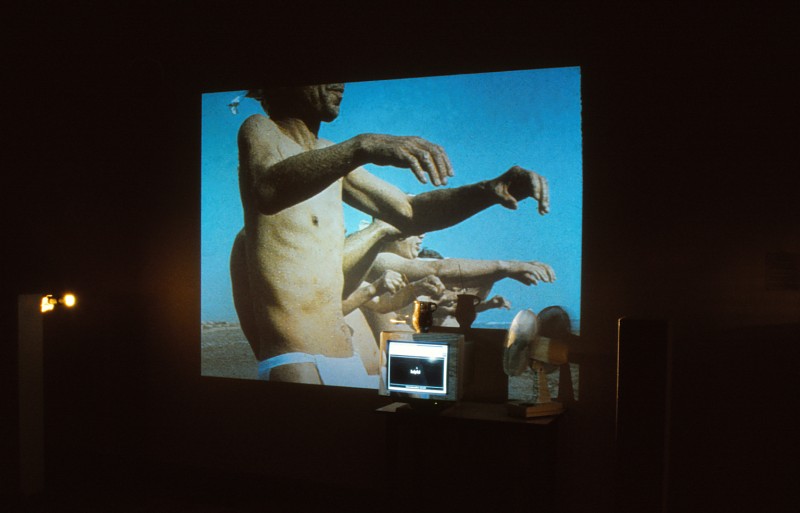
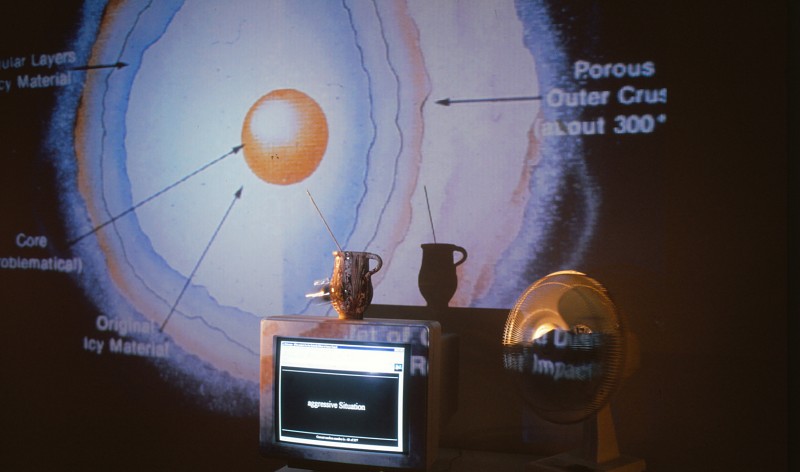
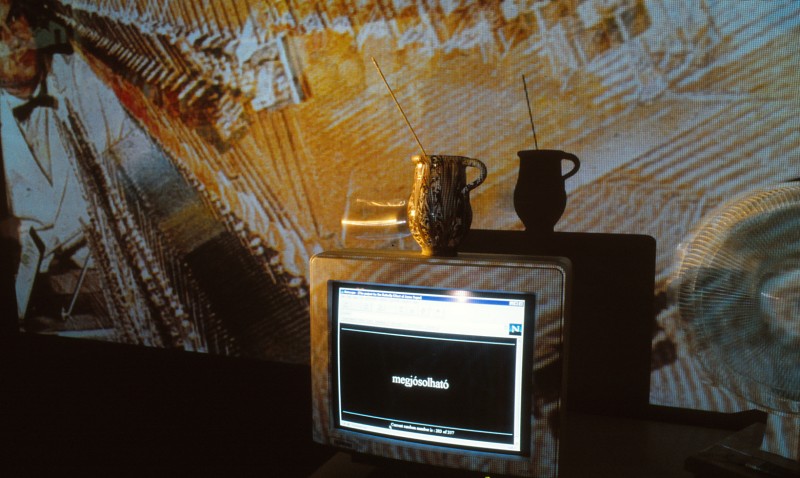
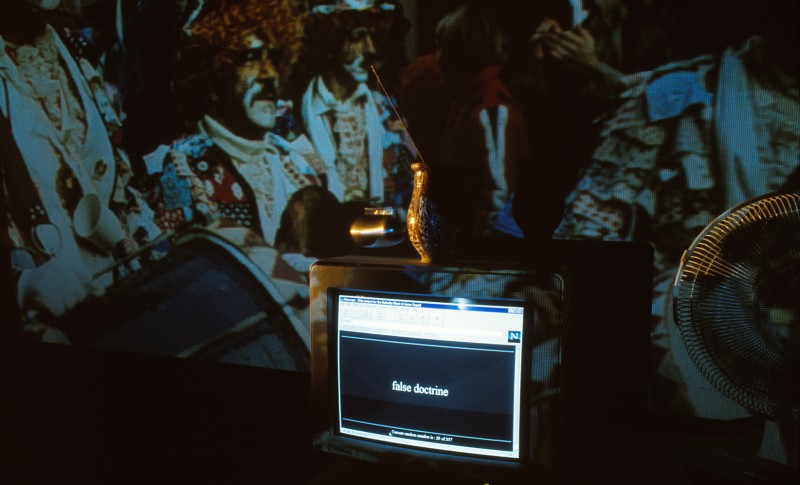
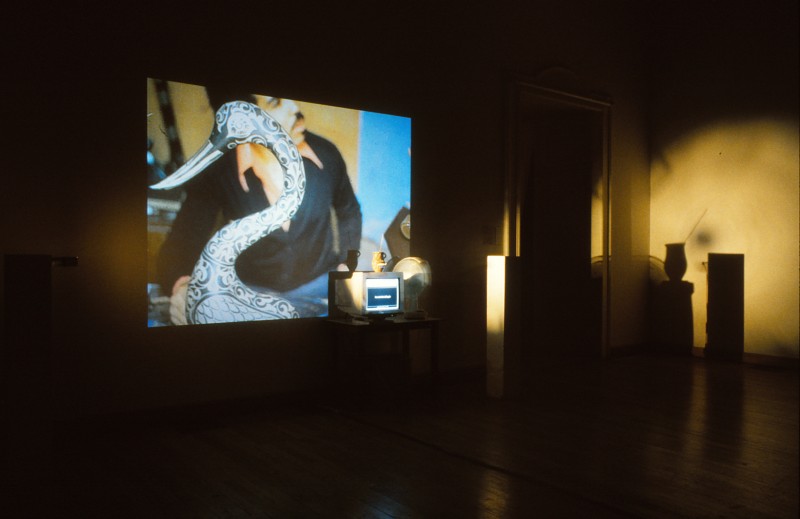
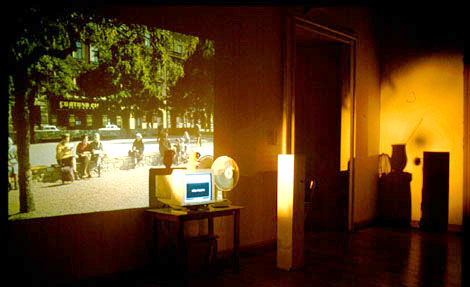
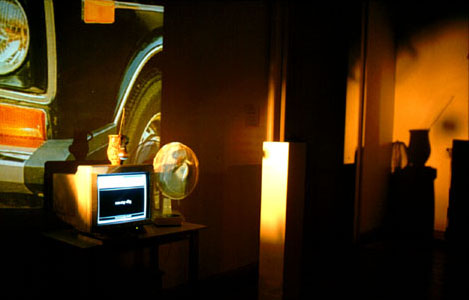
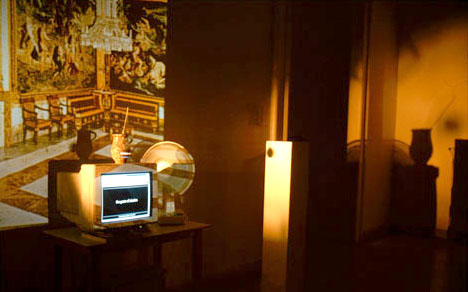
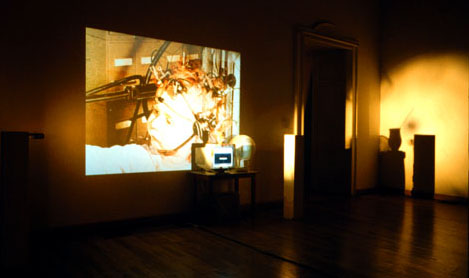
János Sugár’s Reference Generator was One of the first installation works in Hungary to base interactive participation on internet infrastructure. The work was featured at The Butterfly Effect, a comprehensive media art historical exhibition held at the Kunsthalle Budapest in 1996. The exhibition marked an important turning point in Hungarian media art: its success, supported by the Soros Foundation, led to the founding of C3 only a few months later. Reference Generator consisted of a computer and a fan placed on a table in a dimly lit room, with a projection on the wall behind it. The fan moved a Christmas tree ornament suspended in front of it, whose swinging motion visitors could also influence. This movement controlled a random generator through photocell transmission. The word or concept selected by the generator from a collection of approximately four hundred entries appeared on the computer screen, while the system simultaneously projected images chosen at random from a database containing hundreds of items. Most of these images originated from the archives of the Society for the Dissemination of Scientific Knowledge (TIT). The resulting constellations encouraged visitors to create associations between verbal and visual information. The lexical database was partly shaped by suggestions submitted by visitors via e-mail, thus incorporating audience interactivity into the work itself. Since the computers in the exhibition space provided publicly accessible and free internet access — for the first time in Hungary — visitors could also expand the database on site. Sugár’s work explored the transformative processes of reference-making through digital information linking. Owing to its thematic structure, the projected images emphasized the interdependence of different scientific disciplines, pointing toward the growing importance of interdisciplinarity within the emerging digital revolution. Describing the artwork, Sugár stated: “Computer technology makes it possible to recreate a lacking cross-referential matrix, since the most diverse types of information are stored in the same way. Due to high-speed data processing, a large amount of complex data is continuously available, easy to handle, and accessible to all.” Chance, used here as an organizing principle, functioned as a catalyst for creativity, while the installation format emphasized the embodied experience of associative systems and the possibility of physical interaction. Sugár’s work reflected both on the new possibilities for free reference-making enabled by hypermedia and on the urgent need to loosen the rigid structures of scientific discourse through the internet.
TEXT is an Excerpt from Flóra Barkóczi: The Euphoria of Multimedia. Responses to the Emergence of the Internet in the Hungarian Art of the 1990s, Technocool. Exhibition Catalogue, Hungarian National Gallery, Budapest, 2023, pp. 50-51.
More info and sources of images: http://catalog.c3.hu/index.php?page=work&id=1025&lang=HU and http://www.c3.hu/scca/butterfly/Sugar/projecthu.html